Self-Bondage Release Methods Compared: Ice, Candle, Timer, Magnet & More
The whole magic of solo play lives in a single promise: you will be free again, at a moment you designed yourself. That promise is what turns restraint into anticipation and helplessness into pleasure. Which is why the release is never a footnote to the scene. It is the scene. Choose it well and everything else can soften and unfold. Choose it carelessly and even a beautiful setup becomes a gamble.
This guide compares the release methods people actually use, from the elegant and fail-safe to the creative and risky. The goal isn’t to crown one winner, but to help you understand how each one behaves, especially in the moment something doesn’t go to plan, so you can choose with confidence.
⚠️ Disclaimer: Self-bondage always involves inherent risk. This article offers guidance, not guarantees. Assess your own limits, health, environment and gear carefully. Always pair your release with an immediate emergency option, and seek support from experienced practitioners for any advanced scenario.
Two Questions to Ask of Any Release
Before you compare brands or techniques, ask two simple questions of any release method:
-
Is it fail-safe?
A fail-safe release opens because something went wrong, not in spite of it. If the power runs out, the battery dies, or the mechanism breaks, it lets you go. The opposite is a method that needs energy, electronics, or a perfectly executed action to open. When those fail, they keep you bound. That single distinction matters more than price, looks, or cleverness. -
How does freedom actually reach you: by time, by effort, or by distance?
Some methods open on their own after a set time. Some deliver a key you still have to find and use. Some require you to travel or solve a task. The further freedom sits from your hands, the more can go wrong between you and it. Keep both questions in mind as we go.
At a Glance
| Method | How release happens | Reliability | Watch-outs |
| Magnetic lock (like MagBound®) |
Opens the instant power stops |
Very high (fail-safe) |
Needs a correct powerbank setup, never wall power |
| Ice lock (like FrostLock®) |
Opens as the ice melts |
High (fail-safe) | Time varies with room temperature |
| Frozen key in ice |
Key emerges as ice melts |
High (fail-safe | Key can shift; timing drifts |
| The candle | Thread burns through, key drops | Low | Open flame; draughts can extinguish it |
| Analog clock | Key slides off a moving hand |
Low to medium | Key can snag; clock can stall |
| Phone vibration | Alarm vibration tips the key off | Low | Cases, crashes and updates ruin it |
| Timer box / safe |
Box unlocks after set time | Low to Medium | Useless if you can’t see or reach the dial |
| Combination lock + light/timer |
Code becomes readable when light comes on |
Medium | Useless if you can’t see or reach the dial |
| Mains timer (driving a magnet/fan) |
Timer cuts a thread or drops a key | Low to medium | Wall power isn’t fail-safe; use several in series |
| Marketplace electronic time lock |
Motor releases after countdown |
Low | Often needs power to open; not fail-safe |
| Distance / task release | You travel or solve a task to reach the key | Low | Discovery, falls, stamina; emergency release essential |
Fail-Safe by Design: The Gold Standard
These two methods share the quality that matters most: they open on their own, and a failure makes them open sooner, not keep you trapped.
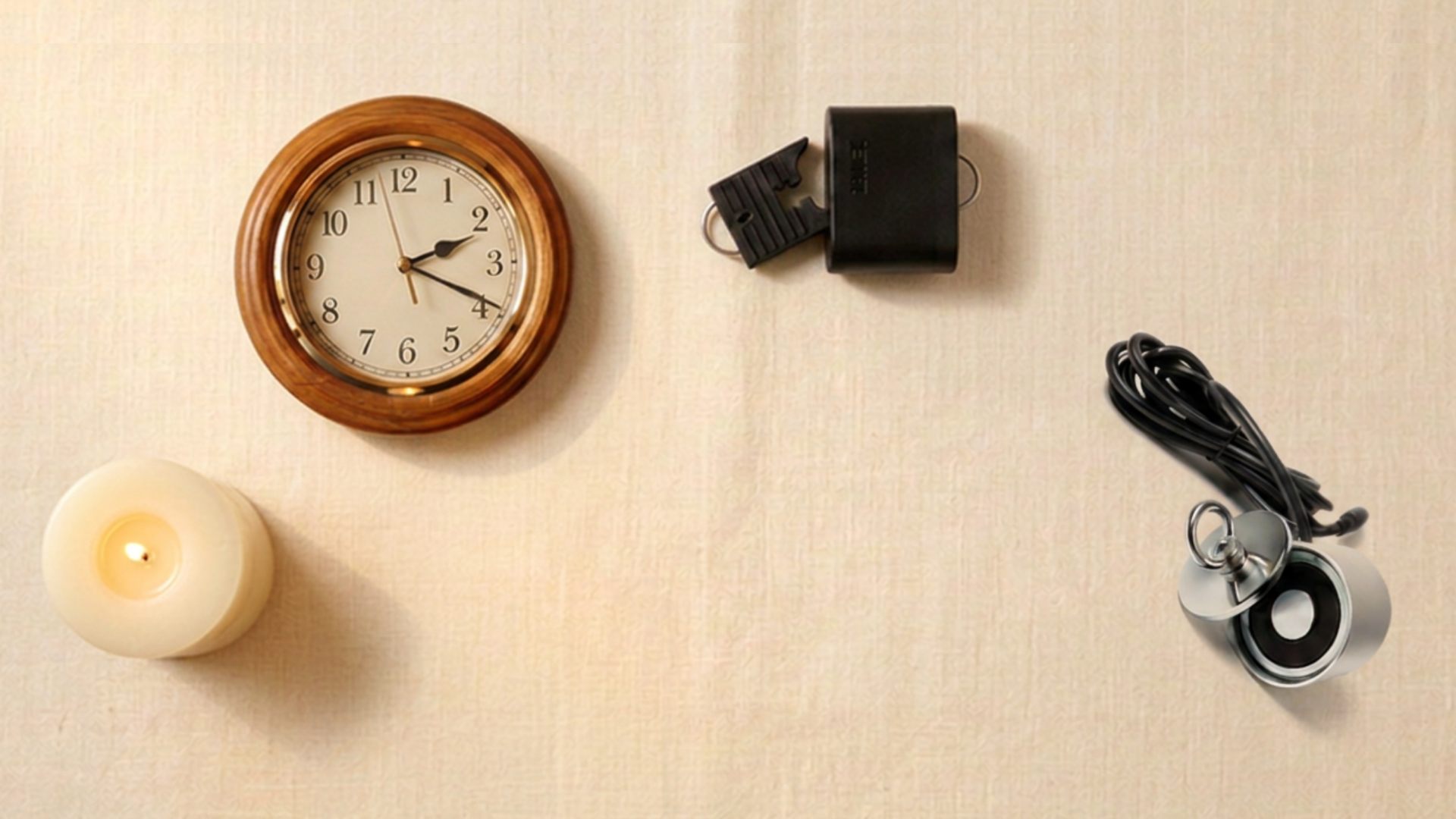
Magnetic lock (MagBound®): An electromagnet holds the lock closed only while it receives power. Cut the power and it releases instantly. Run on a powerbank, that becomes a built-in safety net: when the battery empties, the timer ends, or anything goes wrong, the lock opens. Because it closes with a simple touch and needs no second hand, it’s uniquely suited to fixing each wrist independently and to hands-free, precisely timed sessions. The trade-off is that the setup matters: it must run on battery, never mains, and never on the neck. For the practical details, our MagBound® Time Lock FAQ covers powerbank setups, timers and troubleshooting.
Ice lock (FrostLock®): Two halves freeze together in your freezer and separate only once the ice has melted. There’s a quiet poetry to it: the slow drip is a reminder that freedom is on its way, and the same fail-safe logic applies. Short of a near-freezing room, it will open. The one variable to respect is temperature. Melt time can swing by up to half depending on how warm the room is, and nights are cooler than afternoons, so always test under the same conditions you’ll actually play in. Explore the range under FrostLock® ice locks.
If you want the calmest margin for error, start with one of these two. A release that opens because the battery died or the ice melted is working with you, not against you.
Timed Key-Release Methods: When the Key Comes to You
These methods are popular and endlessly creative. The shared principle: a key is kept away from you, then delivered after a set time. The shared weakness: the key still has to reach your hands. If it falls out of range, rolls away, or you can’t see or move enough to retrieve it, a clever plan turns stressful fast. Build in generous reach and a backup before relying on any of these.
Frozen key in ice: A key (or a carabiner on a chain) is frozen in a block of ice and surfaces as it melts. Simple, low-tech and atmospheric. Just remember the key can shift inside the block, and melt times drift with room temperature.
The candle: A thread runs through a candle with a weighted key on the end; as the wax burns down, the thread releases. It’s the most atmospheric option here, and also the one that demands the most caution: it’s an open flame, a draught can extinguish it, and you cannot supervise a candle while bound. If you’re drawn to this ritual, treat fire with real respect.
Analog clock: A key hangs from a clock hand and slides off as the hand rotates, a playful way to set a short timer. Keep it light: the key can snag, and a stalled clock means a stalled release.
Phone vibration: A weighted key rests on an edge, held only by the corner of a phone; a vibration alarm nudges it off, allowing minute-precise timing. Charming in theory, but phone cases dampen the buzz and a crash or update can cancel the alarm entirely. Test thoroughly and never lean on it alone.
Timer box or safe: Lockable containers that open after a set countdown can hold a key for you. Quality varies enormously, and budget units have been known not to open at all, so only consider one you could break into in an emergency, and always pair it with a backup.
Combination lock + light or timer: A combination padlock can only be opened when you can see the dial. Switch the light off for the night (or onto a timer) and the code becomes readable only later. The lovely thing here is redundancy: using several combination locks where opening any one frees you costs nothing extra and dramatically softens the consequences of a single jam.
Electronic Timers and Marketplace Time Locks
Mains timer setups: Inexpensive plug timers can drive almost anything: a small fan that cuts a thread, or a magnet that drops a key. They’re flexible and cheap, but mains power is not fail-safe: a timer can stop or be mis-set, so wire several in series and always add an emergency release.
Marketplace electronic “time locks:" Compact, display-equipped time locks sold cheaply online are tempting, and the underlying idea is smart. But many share a critical flaw: they need power to open. A drained or failed battery doesn’t release you. It traps you. Build quality and charging electronics are often unreliable, and failure after only a few uses is not unusual. If you experiment with one, assume it can fail and plan a way out. This gap, clever timing without fail-safe security, is exactly why we developed MagBound® and FrostLock® in the first place.
Distance and Task-Based Releases: Advanced and Higher-Risk
Instead of bringing the key to you, these put distance between you and freedom: across a room, a garden, or a sequence of tasks you must complete. They can be the most intense and imaginative scenes, but they carry the highest risk: discovery, falls (especially with bound feet, where you can’t catch yourself), and the simple reality that stamina and patience may run out before you reach the key. These belong firmly in advanced territory, only with a dependable emergency release and a hazard-free space. If you’re newer to solo play, our Self-Bondage & Solo Play guide is a gentler place to begin.
Your Emergency Release Is Not Optional
No matter how reliable your main release, an immediate backup is part of every responsible setup, because a backup answers the one failure a timed release can’t: needing to get out now. A few principles:
- A second key, kept reachable. And ideally several padlocks each with their own key, so a single jammed lock or snapped key never means total entrapment.
- Safety scissors or cutters within arm’s reach. Anything that can free you without a key. Raise the bar to discourage casual use, but make sure it’s genuinely reachable in a crisis.
- Redundancy over single points of failure. Doubling up a release doesn’t let you
escape early, but it quietly removes the scenarios that turn a scene into an emergency. - A trusted person, where possible. The best safety net of all is someone who knows
your plan and can check in.
We go far deeper into hazards and how to minimise them in Risks in Self-Bondage: What to Watch Out For. Essential reading before any solo session.
Choosing Your Release
AoB’s principles for a release you can trust:
- Favour fail-safe methods that open when power, ice or mechanism gives out
- Keep the moment of freedom reachable, never dependent on fine motor skills or perfect calm
- Always pair a main release with an immediate emergency option
- Build in redundancy: two simple safeguards beat one clever one
- Test every method under the exact conditions you’ll play in
- Start shorter, looser and simpler than your fantasy suggests
A well-chosen release doesn’t dull the thrill. It’s what makes the thrill repeatable. When you trust the way out, you can finally let go into the scene.
Ready to build a release you can rely on? Explore our fail-safe MagBound® magnetic locks and FrostLock® ice locks, or browse all locks to find the rhythm that’s right for you.